Treat biodiversity as a living safety net to secure food, protect health, and cut flood losses across South Asia
Nature’s safety net is coming apart. A landmark United Nations assessment warns that up to one million species face extinction within decades, with grave impacts on people around the world. “We are eroding the very foundations of our economies, livelihoods, food security, health and quality of life worldwide,” concluded its authors.
South Asia sits on the front line of this crisis. From the Himalayas and the Gangetic plains to the Sundarbans mangroves and coral reefs, these ecosystems support hundreds of millions of people. Yet climate shocks now strike landscapes already stressed by overuse, pollution, and reckless land use. Wetlands and floodplains have shrunk, rivers carry mounting loads of waste, and cities sprawl into marshes that once soaked up monsoon rains. Colombo, Sri Lanka’s rapidly growing coastal capital, learned this the hard way.
As the city expanded into the surrounding marshes and wetlands, it lost the natural water-storage systems that once absorbed monsoon rains. In recent years, this wetland loss has contributed to recurrent urban flooding, damaging homes, disrupting transport, and overwhelming drainage systems. When natural buffers fade, every shock lands harder and recovery costs climb higher. A report by the World Meteorological Association states that forests, wetlands and lakes provide “hazard-mitigation” services, such as regulating water flows, which means fewer shocks to infrastructure and higher resilience.
Lessons Across South Asia
Bangladesh shows how quickly ecological decline becomes a human crisis. As wetlands shrink and rivers silt up, native fish decline. Fish is the most important animal protein after rice, and Bangladeshis consume one of the highest per-capita amounts of freshwater fish in the region. The International Union for Conservation of Nature (IUCN) found in 2015 that 64 of 253 native freshwater fish species are threatened with extinction.
In Dhaka, paving over ponds and canals traps heat and water, creating warm, stagnant conditions where Aedes aegypti mosquitoes, which spread dengue fever, can easily breed. Dengue is a viral disease that causes high fever and can be severe, and outbreaks now tend to hit densely populated low-income neighbourhoods hardest, where drainage is poor and people live and work close to standing water. A remote sensing analysis published in the International Journal of Environmental Research and Public Health shows higher dengue incidence in urban heat island zones with less vegetation and fewer water bodies. Planners report that Dhaka has lost about 36% of its water bodies since 2010, with water now covering only about 2.5% of the central city area, compared with the 12 to 15% that urban planners recommend.
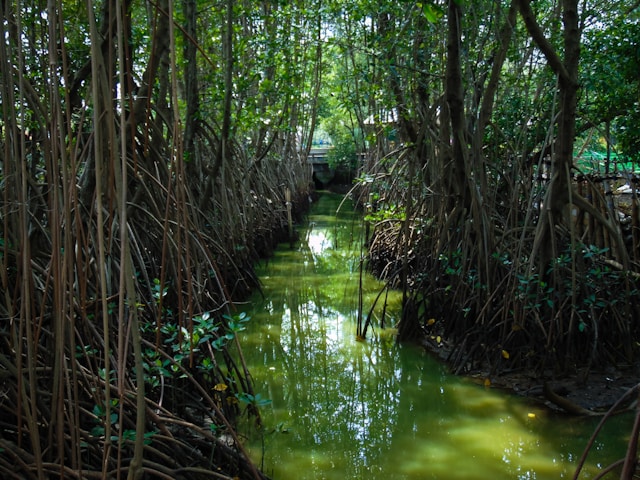
Along the Bangladeshi coast, the Sundarbans, the largest continuous mangrove forest in the world spanning across Bangladesh and India, still takes the first blow from cyclones. Cyclone Remal, which made landfall in May 2024, reminded the country that each storm weakens this living shield. After Remal, officials confirmed at least 39 deer died and saltwater flooded the forest for up to 36 hours. This saltwater inundation led to about 100 fresh water ponds being submerged – a vital source of fresh water sustaining wildelife– and many trees being uprooted. With wildlife and local communities heavily relying on this natural resource for protection and sustenance, the needed response is to treat wetlands, forests, and pollinators as essential public infrastructure considering it provides food security, public health, and climate resilience simultaneously.
In Nepal’s valleys, a bare slope can turn summer rains into a landslide. After a deadly slide in Lapilang in Dolakha district, villagers organised through local user groups to rebuild the hillside with stone terraces, native trees and grasses, and small recharge ponds that help rainwater soak into the soil instead of rushing downhill. The rains still come, but runoff is slower, soils hold together better, and village springs are beginning to flow more reliably again. A United Nations Environment Programme (UNEP) Brief documents how similar ecosystem-based adaptation measures in Dolakha and other districts are helping to stabilise hillsides and protect tens of thousands of people.
In farms across India, pollinators such as bees and butterflies are declining because of habitat loss, intensive pesticide use, monoculture farming and a changing climate, all resulting in fewer fruits and vegetables on the table. A modelling study in Environmental Health Perspectives finds that inadequate pollination is already causing an estimated hundreds of thousands of premature deaths each year by reducing the availability and increasing the price of healthy foods like fruits, vegetables and nuts. The Food and Agriculture Organization (FAO) of the United Nations reports that animal pollinators support about one third of global crop production, showing that protecting them is as much a food and public health priority as it is an environmental one. Across India and South Asia, farmers and governments are beginning to respond with pollinator friendly practices, including integrated pest and pollinator management, planting flowering strips and hedgerows, reducing the most harmful pesticides and supporting beekeeping to restore pollination services and rural livelihoods.
Sri Lanka has begun to work with water rather than fight it. Wetlands - once dismissed as wastelands - are now being protected as living parks that store monsoon water, cool neighbourhoods, and ease floods, while also serving as havens for biodiversity that support rich communities of plants, fish, birds and other wildlife. Ecosystem services evaluations by the World Bank and Global Facility for Disaster Reduction and Recovery (GFDRR) show that these marshes can hold a large share of storm runoff and reduce peak flooding when combined with better drainage. By lowering flood levels around nearby settlements, wetlands help protect thousands of residents, homes, roads and public facilities from damage during heavy rains.
But progress is not a force field; it needs constant political will, funding and enforcement to hold. Less than a year ago, heavy rains still brought deadly floods and landslides across western and southern Sri Lanka, including the capital region. Dozens died and thousands were displaced. The takeaway is not to abandon wetland protection but to double down on it, expand protected areas, and enforce land use rules so homes and hospitals do not sit in the path of the next surge.
Pakistan learned the cost of pinched rivers in 2022, when embanked and narrowed channels could no longer spread across their natural floodplains, which then contributed to turning monsoon rains into a nationwide flood disaster. Monsoon floods affected an estimated 33 million people and damage cascaded through farms, towns, and clinics. Scientific assessments and United Nations reports describe a countrywide disaster, with vast areas under water at the peak. Where floodplains are encroached and channels narrowed, water seeks the next available space, often a village school or a health post. The fixes are plain. Reopen room for the Indus river and its tributaries, repair upstream watersheds, and stop building where the river must breathe.
If these examples all share a common message, it is this: Nature is not a backdrop to development. It is the first line of defense and a foundation for prosperity. When policy protects forests, wetlands, pollinators, and river corridors, food and health outcomes improve and disaster losses fall. When policy ignores them, every shock becomes costlier. South Asia has already tested both approaches. The prudent choice is to scale what works and let ecosystems and local knowledge lead.
The Value of Nature: The Blind Spot in Policy
Why do nature-based solutions, including models of living with water and encouraging biodiversity, still sit at the edge of policy and budgets?
Plans promise resilience, yet wetlands are filled for housing developments and rivers are left to choke on agricultural runoff. Government ministries pull in different directions: each agency focuses on delivering its own targets and projects, often with limited coordination or joint planning, so agriculture, urban development, and disaster management move discrete priorities forward on different timelines, moving on separate tracks, often leaving nature to fall through the gaps. Global assessments have flagged this undervaluation of ecosystems and fragmented governance for years, showing how policies continue to treat wetlands and river systems as spare land or waste channels rather than critical protective infrastructure, and how responsibilities for managing them are split across multiple institutions. The solution includes counting ecosystem services in political and development decisions. The United Nations adopted ecosystem accounting in 2021, giving governments a common way to record ecosystem services and assets; the World Bank’s WAVES partnership similarly shows how countries can put this into practice. But the deeper issue is visibility. Ecosystem benefits - such as avoiding floods, fish die-offs, the protection of clean water, and building of cooler streets - rarely appear in policy and national accounting ledgers until these ecosystems have disappeared and the loss of their benefits have real economic impacts. The Dasgupta Review from the UK Treasury concluded that nature should be treated as economic capital so these benefits are measured, managed, and financed.
Embracing Nature: Ecosystem-Based and Locally Led Solutions
The next step is to plan with nature as our policy partner, and to back solutions that are already working instead of treating ecosystems as an afterthought. We can integrate nature-based solutions in our climate and development planning as deliberately as we plan for food, water, and infrastructure. That means mapping forests, wetlands, river corridors, and pollinator habitats, granting them legal protections, and recognizing their real-world and economic value in national budgets. Like roads and power plants, they should be treated as strategic assets, maintained by an agency with clear responsibility so they do not vanish as a side effect of development.
We should also support and replicate solutions already working on the ground. In coastal Bangladesh, a government-supported “Forest-Fish-Fruit” model planted mangroves alongside ponds and fruit trees, creating green belts that blunt cyclones, store carbon, and boost incomes. In Nepal’s hills, farmers have restored terraces, planted trees, and built small reservoirs to hold rainwater through the dry season, reducing landslide risk and securing water. These are not experiments; they are proven ways to live safer and better using nature as a powerful and low-cost tool to help ensure resiliency.
Community-led ecosystem-based adaptation works when people have the requisite resources, technical help, and decision-making power to maintain and expand these adaptations. Measuring avoided losses, increased incomes, and an increasing number of days of essential services being provided after a shock turns “green” approaches into nature-based solutions backed up by hard evidence. The fewer days a village is cut off by floods, the more crops pollinators save, the more damage a mangrove forest prevents in a cyclone-the easier it becomes to prove that investing in nature is not charity, but smart economics and shrewd climate policy.
Reframing Nature as Infrastructure for Resilience
We do not exist separate from the natural environment – nature is not a “side issue”. It is living infrastructure that feeds us, cools our cities, slows floods, and keeps water clean. We would never skip maintenance on a bridge or a power plant. We should not skip care and conservation of our forests, wetlands, wild lands, and pollinators.
If South Asia treats a mangrove belt or a pollinator network as a strategic asset, the region as a whole benefits and will be safer, healthier, and better prepared for a warming world. Let South Asia’s promising work be an example for regions globally, too, on the power of working with nature as an ally in the struggle to safeguard our communities, our diversity, cultures, and ways of life.
Malik Al Hasan Shuvoworks as a Research Intern at International Centre for Climate Change and Development (ICCCAD) and graduated from the Department of Disaster Science and Climate Resilience at the University of Dhaka. Author attests their piece was written without AI.


